
Just Friends (DVD) Review by Britt Gillette
A somewhat hilarious and charming romantic comedy, Just Friends explores the innermost depths of the infamous "friend zone" of male/female relationships. Directed by Roger Kumble, the brains behind the widely lauded film Cruel Intentions (1999), the film has a novel premise, and although not the funniest comedy to hit the big screen in the past few years, it does have some really funny moments. Adam 'Tex' Davis makes his debut as a screenwriter after extensive work in cinematography and TV writing, and his efforts are above average, but Just Friends is not in the same league as similar themed contemporaries such as There's Something About Mary (1998) and Meet The Parents (2000). Nevertheless, it's a film well worth seeing...
Just Friends follows the life of Chris Brander (Ryan Reynolds), a formerly obese New Jersey high school student in love with classmate Jamie Palamino (Amy Smart). However, Chris long ago fell into the "friend zone," and although, he spent much of his adolescence bonding and building memories with Jamie, she never saw him as anything more than a friend. At their 1995 graduation party, Chris vows to reveal his true feelings, but his well-intentioned attempt blows up in his face when a jerk classmate humiliates him in front of his peers. Enraged, Chris vows to leave town and "become somebody".
Fast forward ten years to 2005, where Chris is a thin, romantically smooth and wealthy record executive living in Los Angeles. He lives in a multi-million dollar house, drives a flashy sports car, and dates a string of beautiful models. Against his wishes, Chris is forced to watch over one of the company's hottest pop artists, the ditsy and annoying Samantha James (Anna Faris). En route to Paris, their jet becomes grounded in New Jersey, and Chris is left with no alternative but to return home. While there, he's reminded of his lifelong crush on Jamie. With newfound confidence, Chris sets out to win over Jamie, but in so doing, he doesn't act like the real Chris, and his actions have the opposite effect. Meanwhile, a rival suitor from high school, a guitar-playing nice guy named Dusty (Chris Klein), enters the picture. His courtship threatens to ruin Chris's latest pursuit of Jamie, but in the end, the only impediment to Chris's lifelong dream is himself...
Cut from a formulaic genre, the resolution of Just Friends is rather predictable. But moviegoers don't watch these types of films for suspense; they only want to laugh. And anyone who enjoyed Ryan Reynolds in National Lampoon's Van Wilder is going to enjoy his performance in this film as well. Although not as well-written as the aforementioned film, Reynolds helps prop up the script with a well-cast comic persona akin to Owen Wilson and a straight-face delivery that would make Leslie Nielsen jealous. In fact, Just Friends is a good pick for those hoping to just laugh out loud. Two particularly hilarious scenes come to mind, one in which Chris makes an unexpected return to the ice rink after busting his lip, and one in which he receives an unexpected hand-hold while watching The Notebook. The latter is especially hilarious, and Adam Davis deserves extra credit for creating this classic and original scene. In the end, Just Friends will never garner the status of all-time comedy cult classic, but for the present day, it more than fulfills its promise to create laughter.
Ryan Reynolds
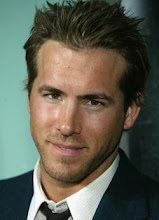
CLASSIC Ryan Reynolds!
Monday, July 24, 2006
Just Friends (DVD) Review

That May Well Be True-Ryan Reynolds
That May Well Be True by Joel Hirschhorn, (Variety)
Peter - Josh WeinsteinJoy - Erin Quinn PurcellRussell - Daniel Milder Jay Reiss' "That May Well Be True," making its world premiere at Hudson Mainstage, is an angry and penetrating exploration of friendship ruined by resentment and jealousy. Reiss has a knack for writing hostile confrontations and charging every scene with suspense. But the production is also clearly intended to be humorous, and the author's witty lines would be funnier if directed in a freer, less sober style. Adversarial tension is sparked when novelist Peter (Josh Weinstein) fights a plagiarism lawsuit instituted by his old pal Russell (Daniel Milder), a former drug addict. Russell had wild experiences in Mexico that Peter utilized for a new bestseller, and he wants $700,000 of the fee promised to Peter for his screenplay of the novel. When Peter shows up unexpectedly at Russell's Westchester apartment to hash out the problem, lifetime grievances are aired that aggravate their bitterness. Prominent in the mix is Russell's roommate Joy (Erin Quinn Purcell), an economist who has been hired to counsel an Indian ashram on how to increase its profits. Russell amusingly defines their relationship as similar to a marriage ("We eat together, we bicker in front of friends, and we don't have sex"). Portraying Peter, Weinstein conveys the right blend of integrity and self-interest. Milder is a courageous, high-strung actor, and his Russell is a realistic portrait of self-destruction. What upsets the balance in the contest between the two is his exasperating, unlikable attitude: It's hard not to repudiate him even when his viewpoints are justified. An occasional inspired line ("If it wasn't for me, you'd still be listening to Phil Collins and defending it") softens him, but it's not enough to make us care about his fate. The production is at its best during a scene between Peter and Joy. Director Greg Jackson carefully establishes a potentially romantic link between them, and their relationship is so winningly developed that the play falters after their connection is dropped. This portion also features the evening's most inventive bit, when Joy lists her albums of love songs by people who can't sing -- Burt Reynolds, Tony Randall, Lorne Greene, Ed McMahon, Pele and William Shatner doing "Mr. Tambourine Man." The final stages of combat between Peter and Russell consist of a vividly staged physical battle and criticisms flung in titular game "That May Well Be True." These accusations stir up frenzied emotion, although a hint that Russell and Joy may go from platonic to passionate is unconvincing. The climax, in general, would resolve more excitingly with a surprise twist. As it is, events trail off inconclusively, suggesting that the author couldn't quite devise a proper ending. Purcell's Joy is the evening's most notable element. The quietly commanding actress suggests a personality of depth and compassion. Joy is a character who can truly be called original, imaginative enough to indicate that Reiss, though a raw playwriting talent, has a solid theatrical future. Sets, Ryan Wilson; costumes, Erin Quinn Purcell; lighting, Ryan Wilson; production stage manager, Jesse Russell Brooks. Running time: 1 HOUR, 40 MIN. -- A Stephen Solaka presentation of a play in one act by Jay Reiss. Directed by Greg Jackson.
